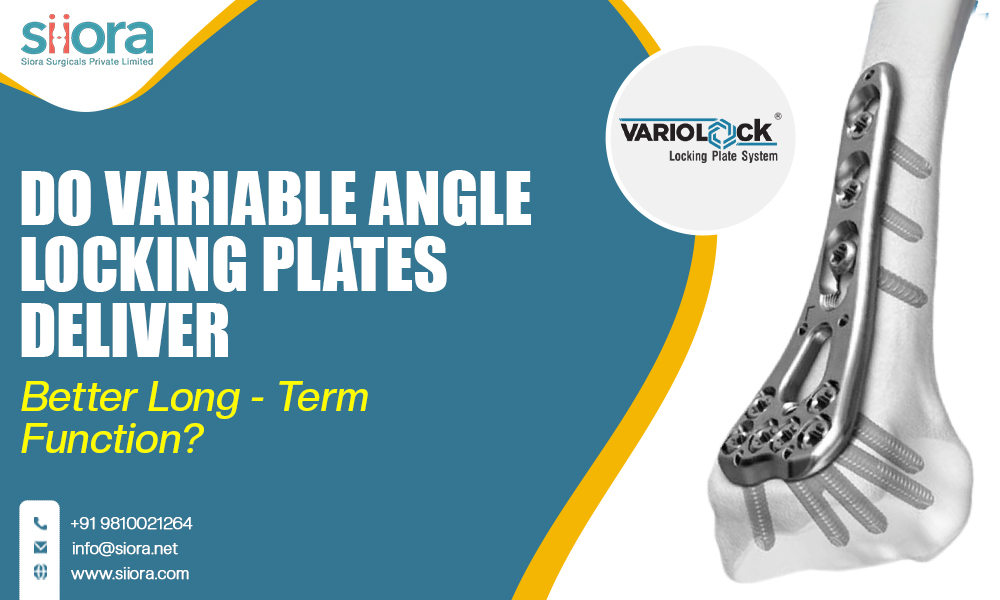
If you ask any orthopedic surgeon what has changed their fracture management routine over the last decade, variable angle locking plates will almost always make the list. These plates didn’t just add a small tweak to standard fixation—they quietly reshaped how surgeons think about stability, bone quality, and patient mobility. But with every new technology, one question lingers: Do these plates actually offer better long-term function, or is the excitement simply about convenience in the OR?
A Plate That Adapts to the Fracture, Not the Other Way Around
Traditional locking systems were dependable, but their biggest flaw was rigidity—once the screw trajectory was fixed, so were your options. Variable angle mechanisms changed that. Surgeons suddenly had the freedom to fine-tune screw direction based on the patient’s anatomy, fragment size, or tricky bone angles.
It may sound like a small advantage on paper, but in real surgical settings—especially around periarticular regions—this flexibility can mean the difference between a compromise and a near-perfect construct.
But Does That Translate to Better Outcomes?
Most surgeons who’ve worked with variable angle plates tend to describe a similar pattern:
Patients move earlier, feel more stable, and show fewer signs of secondary collapse in fragile bone. While these observations are not “headline-grabbing claims,” they paint a consistent picture. Controlled screw placement supports the fracture exactly where it needs reinforcement, helping the construct hold up against early loading.
In long-term follow-ups, many clinicians report reduced hardware irritation and fewer cases needing secondary procedures. This isn’t surprising—when the bone heals in proper alignment and the plate sits comfortably without undue stress, implants simply behave better over time.
A Quiet Advantage in Osteoporotic Bone
Where variable angle plates truly shine is in patients with poor bone density. Trying to find a solid purchase in soft bone with fixed screw angles is like trying to hang a frame on a wall with crumbly plaster—it works until it doesn’t. With variable angulation, surgeons can redirect screws toward stronger bone corridors, improving stability without increasing surgical trauma.
In elderly fractures or complex periarticular injuries, this flexibility often contributes to more predictable healing and better long-term joint function.
Are There Limitations? Yes—But They’re Practical, Not Structural
No implant system is perfect, and variable angle plates are no exception. They rely heavily on the surgeon’s skill and judgment. Poor screw placement or over-angulation can compromise stability just as easily as it can enhance it.
They also come at a slightly higher implant cost, though many hospitals and surgeons feel the improved outcomes justify the difference—especially when it reduces the likelihood of re-intervention.
The Patient Experience Matters Too
From a patient’s point of view, the biggest advantage is often invisible. They don’t see the plate or the screws—they feel the difference in how soon they can move their limb, how confident they feel while walking, and ultimately how naturally the injured joint or bone functions months later.
Patients who receive variable angle locking constructs often report smoother rehabilitation and fewer mobility issues compared to older fixation techniques. These aren’t dramatic overnight changes; they’re quiet improvements that become noticeable as the months go by.
So, Do They Deliver Better Long-Term Function?
In most real-world settings, the answer leans strongly toward yes. Variable angle locking orthopedic implant plates provide more control during surgery, better stability in challenging bone, and fewer complications that can undermine long-term function. They aren’t a miracle device, and they don’t replace surgical judgment—but they enhance it.
 Siora Surgicals Pvt. Ltd.