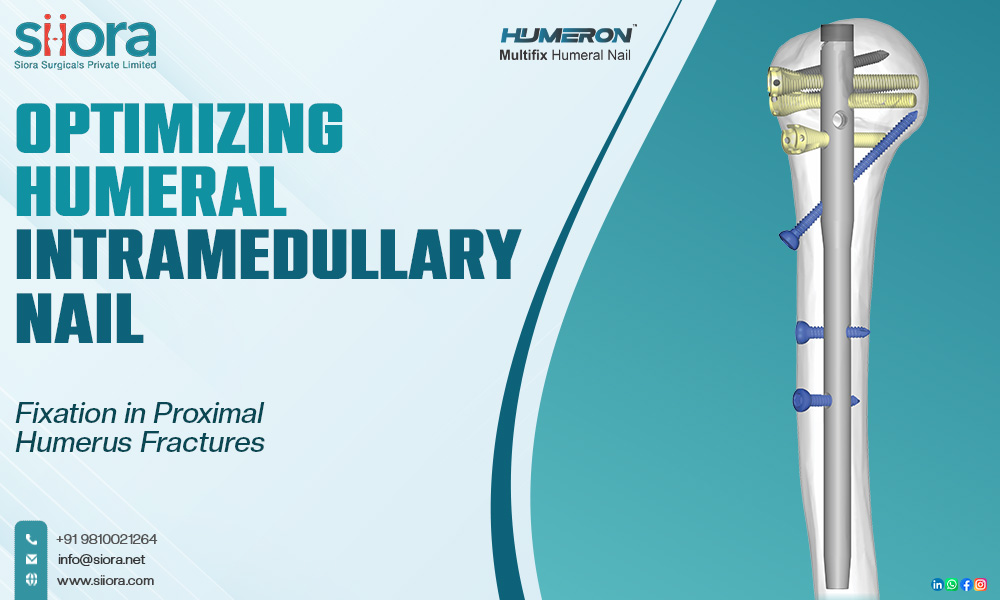
Proximal humerus fractures are a frequent problem, especially among older adults who live with osteoporosis. These injuries, though not always life-threatening, can drastically reduce a person’s independence and long-term shoulder function if not managed correctly. Over the years, surgeons have debated the best way to handle such fractures, moving between plates, intramedullary nails, and even prosthetic replacements in complex cases. Among these, humeral nailing has gained traction due to its minimally invasive approach and its ability to maintain shoulder mechanics when executed properly.
In clinical practice, the technique is not without challenges. Achieving the right entry point and avoiding damage to the rotator cuff are critical steps. A millimeter of error here can mean a visible limitation in shoulder elevation later. Unlike plates, intramedullary nails do not allow for wide correction after insertion, so getting reduction right before driving the nail is essential. Surgeons who routinely perform this technique emphasize the importance of fluoroscopic control at every step.
Why Implants Evolved?
Modern intramedullary implants are no longer the straight rods used decades back. Today, nails are designed with curvature and a slimmer profile to respect the anatomy of the humerus. Multiple proximal locking options give additional stability in complex fracture patterns. For instance, placing calcar screws that support the inferomedial aspect of the humeral head helps prevent collapse into varus, one of the most frustrating complications after fixation.
Real-world results show that these enhancements have made a difference. Ten to fifteen years ago, loss of fixation or screw migration was common. With newer generation nails, surgeons now see better healing rates, even in osteoporotic bone. Still, technique matters more than hardware. A well-reduced fracture fixed with a basic nail often does better than a poorly reduced fracture held with a top-end device.
Complication Avoidance
Every fixation method has its traps. In nailing, shoulder impingement is one such issue. If the top of the nail sits proud, patients quickly complain of painful restriction. Surgeons need to bury the nail just enough, while making sure the screws still have safe purchase. Screw cut-out remains another risk, especially in brittle bone. Some surgeons use augmentation methods, such as bone substitutes, to support the fixation in elderly patients.
An overlooked component in success is rehabilitation. Even the strongest fixation can fail if the arm is neglected in a sling for too long. Early passive motion within days of surgery keeps the joint supple, while gradual strengthening later restores muscle support. Patient compliance here often predicts the return of function more than the implants themselves.
Choosing the Right Patient
Humeral nails are not a one-size-fits-all answer. A young patient with a simple two-part fracture will usually do very well with this method. An 80-year-old with a four-part fracture and fragile bone may not, and in such cases, arthroplasty could be a smarter choice. Imaging, particularly CT scans, gives a clearer picture of fragment orientation and helps in decision-making. Thus, surgeon judgment remains central; technology can only complement it.
Practical Takeaway
Optimizing intramedullary nail fixation of the proximal humerus is less about picking the most advanced orthopedic implant and more about following sound principles. Accurate reduction, careful entry point selection, awareness of anatomy, and respect for postoperative rehab form the backbone of success. When these are applied consistently, patients regain reliable shoulder function, often escaping the long-term disability such fractures can bring.
 Siora Surgicals Pvt. Ltd.